Built With Less. Powered by AI

New data reveals the AI story most headlines are missing — and the founders quietly changing it.
AI is building real businesses in real places:
At the kitchen table.
In the spare bedroom.
At the salon after closing.
In the coffee shop between client calls.
Not talked about. Built. In under 18 months, the AI adoption gap between small businesses and large enterprises narrowed by nearly two-thirds. [2]
That is not a tech industry story. It belongs to the people who didn't wait for a green light — who stepped out on faith before anyone had the chance to say otherwise.
The founder economy just changed shape.
In 2024, women started nearly half of all new U.S. businesses — up from just 29% in 2019. African American-founded businesses grew their share by 67% over the same period. Latinx founders, by 25%. AAPI founders, by 17%. [1]
That momentum was already in motion. AI met it where it was.
A capacity engine that doesn’t cost what it used to.
For these founders, AI is not what it is for a Fortune 500. It is not a restructuring tool or an efficiency layer.
It is borrowed capacity. The business plan they could not afford to outsource. The proposal that used to take a week. The brand language that finally turns “I know what I do” into something another person can act on. The digital presence that used to require an agency, a budget, and a timeline none of them had.
For women, African American entrepreneurs, and every founder building lean, the gap has never only been about ideas. The ideas were always there.
The gap was time. Money. Access. The confidence to show up looking ready before anyone had invested in making you look ready.
AI does not erase those barriers. But in the hands of someone with the drive, the moxie, and the people who believed in them before the numbers did — it provides one more way to climb the mountain that was never supposed to move.

“For founders who have always had to stretch one hour into five jobs, AI doesn’t give them a shortcut. It gives them leverage on what they already have.”
The data is already pointing there. The results are showing up in the revenue lines. 91% of small businesses using AI report increased revenue. [3]
Nearly 8 in 10 African American small-business owners are already using AI — not just for content, but for strategy, decision-making, marketing, and building the actual business. [4]
That is not passive adoption. That is business building.
One in four women plans to start a business in 2026. More than half say they will use AI to help do it. [5]
The equalizer conversation around AI used to be theoretical. The data says it is already happening.
Where this gets urgent for communicators.
For communications leaders — and for every founder who knows that how you say it matters as much as what you say — this is not only a technology story.
It is a messaging story. A trust story. An access story.
A founder can have a sharp service and still struggle to articulate it. A consultant can have twenty years of experience and lose ground to a competitor with a cleaner digital presence. A woman-owned or minority-owned business can be fully qualified and still be underestimated in the first thirty seconds of a search result.
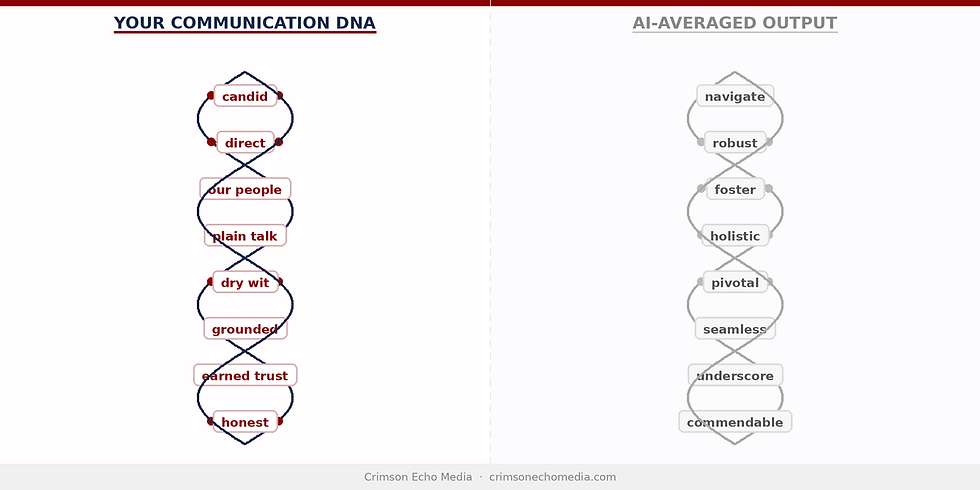
AI can close that presentation gap. But only if it is used with intention — with a voice that is actually yours, a message that builds trust rather than just traffic, and the judgment to know when the tool is helping and when it is making you sound like everyone else.
That is what strategic communications in an AI era looks like. Not prompt tips. Not automation for its own sake.
Clarity. Judgment. A message worth remembering. Because in a noisy market, being understood is often where growth begins. AI, used well, is how more founders get there first.
SOURCES
[1] SBA Office of Advocacy, “AI in Business: Small Firms Closing In,” September 2025. advocacy.sba.gov — Gap measured in percentage points: 4.8pp in early 2024 narrowing to 1.7pp by August 2025. The SBA notes the current AI gap is far smaller than the broadband adoption gap, which took years to close.
[2] Gusto, New Business Formation Report, 2025. gusto.com — Women’s share of new business starts rose from 29% in 2019 to 49% in 2024.
[3] Salesforce, Small & Medium Business Trends Report, 6th Edition, 2025. Survey of 3,350 SMB leaders globally. salesforce.com
[4] Intuit QuickBooks, 2025 Black History Month Small Business Survey. quickbooks.intuit.com
[5] Intuit QuickBooks, Women Entrepreneurs 2026: Trends in Funding, AI, and Growth, March 2026. quickbooks.intuit.com


Comments