Communication DNA

Updated: May 3
The asset AI is quietly averaging out of existence — and the opportunity for organizations willing to protect it
Every organization has a communication identity that is specifically, unmistakably its own. The way leadership speaks in a crisis. The tone that carries through employee communications even when the news is hard. The particular confidence, or warmth, or directness that runs through everything — from the CEO's all-hands address to the HR team's open enrollment email.
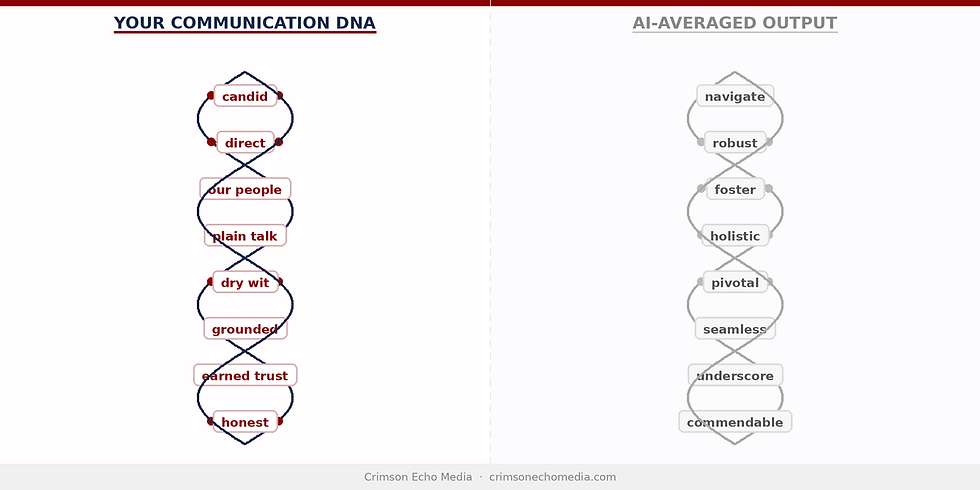
Call it Communication DNA: the specific combination of voice, tone, cadence, and perspective that makes an organization's communication recognizable without a logo attached.
Most organizations have never named it. Many have never examined it. And right now, without most of them realizing it, AI is quietly replacing it with something that works perfectly well — and belongs to everyone.
What Communication DNA actually is
It is not a brand guidelines document. Those describe rules. Communication DNA is the living thing the rules are trying to protect.
It is not tone of voice. Tone is one expression of it. DNA is the source.
It is the accumulated result of how an organization has chosen, over time, to be present in its own words. The specific vocabulary that reflects genuine values rather than aspirational ones. The rhythm of leadership communication that employees have come to trust. The moments of candor, or humor, or specificity that make a message feel like it came from somewhere real.
When it is intact, people feel it without being able to name it. When it starts to go, they feel that too — the slight flatness, the faint sense that communication is coming from a function rather than from a place.
Communication DNA is what makes an organization sound like itself. AI, deployed without intention, doesn't destroy it. It just stops expressing it.
And here is what makes this moment particularly important: the organizations that protect their Communication DNA right now are building an advantage that will compound. Because AI is averaging everyone else toward the same center — and in a landscape of averaged communication, sounding specifically like yourself is increasingly rare.
Three examples of what's already happening
This is not a theoretical risk. It is showing up in documented, specific, measurable ways across industries and communication types.
Example 1: The shareholder letter convergence
The annual shareholder letter has historically been one of the most individually expressive documents a company produces. The best ones — Berkshire Hathaway's, early Amazon's — read unmistakably like the person who wrote them: specific in their observations, particular in their language, impossible to mistake for anyone else's.
One market intelligence platform tracked the spread of identical phrase constructions across corporate documents and found 73 uses in Q4 2025 alone of a construction that had appeared only a handful of times in the previous two decades. The phrases were not wrong. They were just everyone's simultaneously.
Shareholder letters, earnings call scripts, and board communications — the documents most responsible for expressing organizational character and leadership voice at the highest level — are converging on the same language. Not because leaders are less thoughtful. Because the tools they are using are trained on the same source material and optimized for the same professional average.
When the most important communication your leadership produces starts to sound like the most important communication every other leader produces, you have not just lost a document. You have lost a signal — the signal that tells your most important audiences who you actually are.
Example 2: The AI fingerprint in internal communications
The evidence of Communication DNA erosion is not only visible in external-facing documents. It is showing up inside organizations in the texture of everyday communication — all-hands emails, manager updates, change announcements, the messages that carry culture as much as information.
Linguists at University College London analyzed five million scientific papers and found a measurable pattern: words like "meticulously" up 137%, "intricate" up 117% — a fingerprint spreading across professional writing that correlates directly with AI adoption. Words like "navigate," "underscore," "foster," "robust," and "seamless" are appearing with algorithmic regularity across industries and functions. The vocabulary of a hundred different organizations is converging on the same set of approved-sounding terms.
This matters internally because Communication DNA is one of the primary carriers of culture. When the CEO's all-hands email could have been written by any CEO's AI assistant — when the HR communication reads like the HR communication from the company across the street — something has shifted. Not in the facts conveyed. In the felt sense of whether leadership is genuinely present.
73% of consumers say they can already spot and reject AI-generated marketing. Employees are audiences too — and they read internal communication with the same instincts. The trust that erodes when communication feels averaged is harder to rebuild than any single message is worth.
Example 3: Executive voice at the highest-stakes moments
In early 2026, the CEOs of Customers Bank, Zoom, and Klarna each used AI clones or avatars to deliver portions of their earnings calls. The technology was sophisticated. Each positioned it as a demonstration of AI leadership. And the coverage that followed was largely enthusiastic about the innovation.
But here is the Communication DNA question the coverage did not ask: when multiple competing executives use the same underlying AI model to shape, script, and now deliver their most high-stakes communications, what exactly remains of the voice that was supposed to be distinctly theirs?
This is not an argument against AI in executive communication. Used well — anchored to a leader's genuine voice, trained on their actual communication history, governed by someone who knows the difference — AI can scale executive presence rather than flatten it. The executives who will stand out are not the ones who use AI less. They are the ones who brought enough of themselves to the process that AI had something real to amplify.
When the voice becomes a product, it becomes everyone's product. The differentiator is not the tool. It is what you bring to it — and whether you have been intentional enough about your Communication DNA to bring anything at all.
Why this creates a genuine competitive opportunity
Language models are trained on the statistical average of everything ever written. When organizations route communication through them at scale — without deliberate voice governance, without anchoring AI to their specific communication identity — every message trends toward that average. Clean. Professional. Technically correct. And completely interchangeable with the organization next to them.
Which means the gap between organizations that protect their Communication DNA and those that do not is widening — quietly, steadily, and in a direction that will be very difficult to reverse once it has gone far enough.
Consistent brand voice can increase revenue by 10 to 20%. Only 30% of companies actively use their brand guidelines. AI, without governance, makes that gap wider — and the cost less visible until it becomes significant.
The organizations that move on this now are not just protecting something they already have. They are building an advantage by contrast. In a landscape where most communication sounds like it came from the same source, sounding specifically and recognizably like yourself is increasingly powerful.
Employees feel it. Customers feel it. Investors feel it. They may not be able to name Communication DNA. But they know the difference between an organization that has it and one that has let it average away.
What protecting Communication DNA actually requires
This is not a brand refresh. It is not a new style guide. Most style guides were written for human writers operating at human speed — they do not account for what happens when a language model interprets "professional but approachable" across ten teams in three regions with slightly different prompting habits.
Protecting Communication DNA in an AI-assisted environment requires three things:
• Knowing what yours actually is. Most organizations have never examined their communication identity with enough specificity to protect it. What are the actual words, rhythms, and perspectives that make your communication recognizable? What are the moments in your communication history that best express who you are? That examination is the foundation everything else builds on.
• Building governance that preserves it at scale. Not bureaucratic policy — practical, accessible guidance that tells teams what AI should draw from, what parameters protect the voice, and what requires human judgment to get right. Teams with clear Communication DNA governance move faster and more consistently than those figuring it out independently.
• Auditing what AI-assisted communication actually sounds like over time. Not one document. The full volume. What does six months of AI-assisted leadership communication sound like read together? Does the voice hold? Is it still recognizably yours? Or has it quietly drifted toward the professional average that belongs to everyone and no one?
How Crimson Echo Media works
This is the work we do at Crimson Echo Media: helping organizations find, protect, and scale their Communication DNA — so that AI makes them more of themselves, not less.
That means:
• Communication DNA audits. A clear picture of what your organization's communication identity actually is, where it is holding, and where it has already started to average out.
• Voice governance frameworks built for AI workflows. Practical guidance your teams will actually use — not documentation that lives in a shared drive.
• Executive voice development for high-stakes communication. So the moments that matter most — the earnings call, the all-hands address, the change announcement — still sound unmistakably like the person delivering them.
• Narrative architecture that anchors AI output to organizational identity. Because governance is only sustainable when it is connected to something real: a genuine point of view, a clear culture, a story worth telling consistently.
The organizations with the strongest Communication DNA right now have an asset that AI cannot generate and competitors cannot copy. The question is whether they know what it is — and whether they are protecting it with the same intention they bring to every other strategic investment.
In a world of averaged communication, sounding like yourself is a strategy.


Comments