Clarity in an Era That No Longer Waits

Updated: Jan 5
It’s probably no surprise to you that we’ve crossed a threshold in how communication works.
Messages are no longer received in sequence or in full. They’re scanned, excerpted, reacted to, and reshaped in real time. Internal and external audiences encounter the same words through different lenses, often at the same moment.
Context collapses. Interpretation accelerates.
In this environment, communication doesn’t just inform.
It creates conditions.
It sets direction.
It signals intent.
It invites interpretation whether leaders intend it to or not.
That shift has made clarity harder to achieve and far more consequential when it’s missing.

The Hidden Cost of Speed
Most organizations are communicating more than ever. Messages move quickly. Tools make distribution easy. AI makes drafting instantaneous.
But speed has quietly displaced judgment.
When communication accelerates faster than shared understanding, leaders lose control of meaning. Not because they said the wrong thing, but because they didn’t anchor what mattered most before speaking. In the absence of clarity, others fill the gaps. Internally, that shows up as misalignment. Externally, it shows up as narrative drift.
The risk today isn’t silence. It’s ambiguity.
Why Clarity Is No Longer a Style Choice
Clarity used to be treated as a matter of tone or polish. Now it functions more like infrastructure.
Clear communication creates alignment before confusion takes hold. It gives teams language they can repeat without improvising. It allows leaders to stay consistent across audiences and moments, even as circumstances change.
Unclear communication does the opposite. It multiplies interpretations. It forces constant clarification. It invites reactive messaging that feels defensive rather than intentional.
In a landscape shaped by speed, overlap, and scrutiny, clarity isn’t about saying more. It’s about deciding more.
AI Didn’t Create This Problem. It Revealed It.
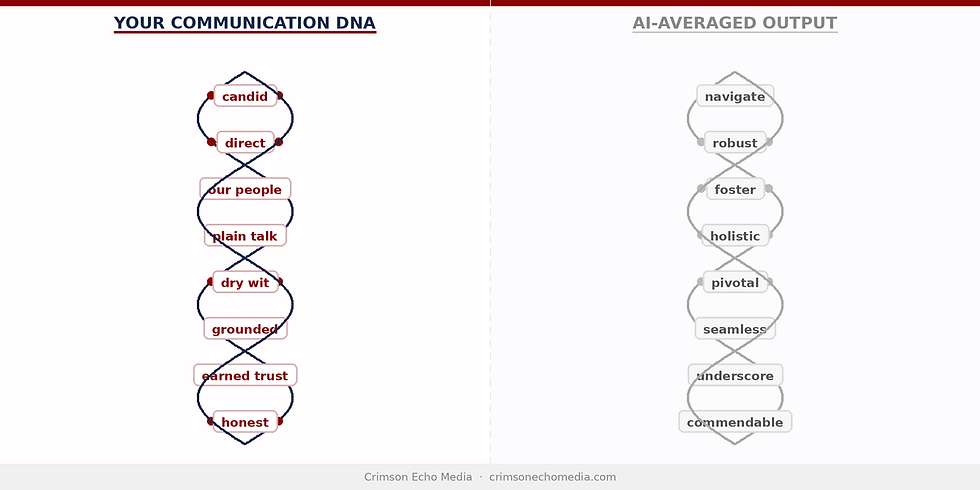
AI has made communication faster, cheaper, and easier to generate. What it hasn’t done is improve thinking.
Organizations with disciplined narratives use AI to accelerate work without losing coherence. Organizations without that discipline use AI to amplify inconsistency, tone drift, and risk.
AI doesn’t correct unclear intent. It scales it.
Which is why the most important question leaders face isn’t how to use AI, but whether they’ve done the work to define what they want their communication to accomplish in the first place.
What Clarity Looks Like in Practice
Clarity shows up when leaders sound intentional rather than reactive. When teams understand not just what’s being said, but why it matters. When messages hold steady under pressure instead of shifting with every reaction.
It’s visible when communication creates confidence even in moments of uncertainty.
And it’s noticeable when it’s missing.
By the time leaders realize clarity has eroded, the narrative has often already moved on.
The Work Beneath the Words
The leaders who navigate this era well won’t be the ones who speak the most or fastest. They’ll be the ones who invest in the thinking beneath the message. Who treat clarity as a strategic capability, not a stylistic preference. Who understand that communication sets conditions long before it delivers information.
At Crimson Echo Media, this is the work we focus on: helping leaders and organizations build clarity that holds as communication speeds up, tools evolve, and the margin for error narrows.
Because being visible is easy now. Being clearly understood is not.

And that difference is where strategy lives.


Comments