Building AI Readiness Beyond the Tools

A Useful Way of Thinking for Communicators
Most communicators now have access to AI tools. What’s less clear is how to use them in ways that feel steady, intentional, and aligned with real work.
Much of the conversation around AI still centers on capability. What tools can do. How fast things are changing. What organizations risk if they don’t keep up. Those questions are understandable. They’re concrete and easy to measure.
But once tools are already part of the landscape, a different challenge tends to emerge. Not adoption, but orientation.
How does AI fit into the work we actually do? How does it affect judgment, consistency, and trust as output scales? And how do communicators make decisions without pretending there’s a single right answer?
There’s no definitive blueprint for AI readiness. But there are useful ways of thinking about it that make the next set of decisions feel clearer and less reactive.
What follows is one such way. Not a prescription. Not a maturity model. A working guide communicators can consider as AI becomes part of everyday work.
Moving the Conversation Beyond Tools
Tool conversations tend to dominate because they feel actionable. They give teams something tangible to compare, evaluate, and debate. But readiness often shows up later, and more quietly. In how decisions are made. In how responsibility is shared. In how consistency is maintained as volume increases.
Teams that feel more grounded in their use of AI often shift the conversation from what tools are available to how those tools fit into real workflows. That shift doesn’t eliminate uncertainty, but it does reduce noise. It creates space for more useful questions.
Orientation Comes First
One place many teams begin is with orientation. Before policies or pilots, leaders often pause to consider what they actually want AI to help with and where human judgment should remain central. This isn’t about drawing rigid boundaries. It’s about reducing ambiguity.
When intent is articulated early, teams spend less time guessing. They gain clarity about when AI support is appropriate, when discretion is required, and where accountability ultimately sits. Readiness often starts with shared understanding rather than formal rules.
Designing for Judgment, Not Just Speed
AI collapses the time between draft and delivery. That efficiency can be genuinely helpful. It can also compress thinking if teams aren’t deliberate.
As drafting becomes faster, many communicators find themselves asking a different question: where does thinking deserve more space now?
Teams that navigate this well tend to be intentional about which decisions benefit from speed and which still require pause. Readiness shows up when speed supports strategy rather than bypassing it. This isn’t resistance to AI. It’s stewardship of judgment.
Treating Voice as Shared Infrastructure
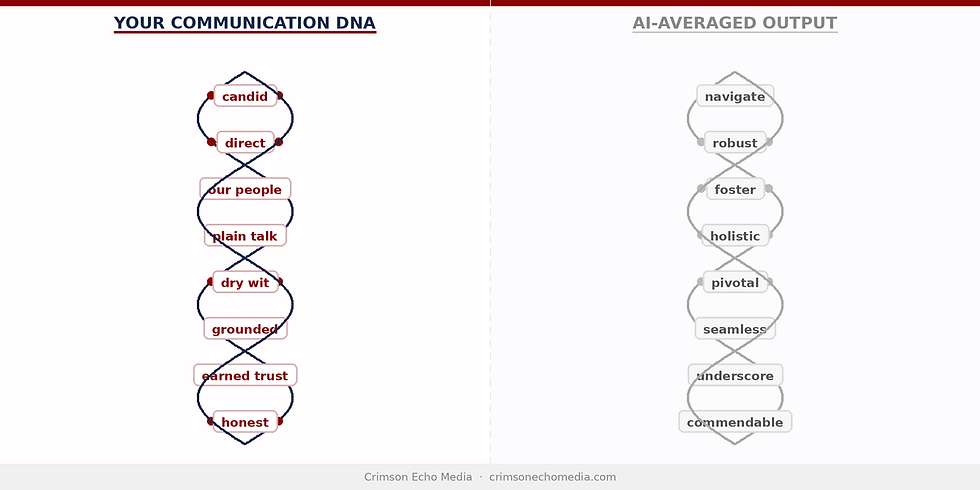
As output scales, voice becomes easier to dilute.
Rather than treating voice as a stylistic preference, some teams begin to treat it as shared infrastructure: something that needs to be defined clearly enough to hold under pressure.
This often leads to conversations about how AI can support drafting without eroding accountability for tone, intent, and meaning. Many teams address this by separating drafting assistance from publishing authority. AI helps generate language. Humans remain responsible for what ultimately represents the organization. That distinction allows efficiency without sacrificing coherence.
Building Capability Inside the Work
Readiness rarely comes from one-time training or standalone initiatives. It tends to develop when people learn while doing real work, with clear expectations and permission to experiment responsibly.
In teams where AI use feels more settled, learning isn’t treated as something separate from the work itself. Instead of carving out special time to “learn AI,” leaders pay attention to where new habits can form naturally inside the workflows people already rely on.
The question becomes less about training programs and more about integration: where can learning happen as part of the work, rather than alongside it? When AI use is embedded this way, confidence tends to grow quietly. Capability builds through repetition, and habits form that last beyond the initial burst of enthusiasm.
Signaling Readiness, Not Mastery
Perhaps the most stabilizing signal leaders can send is that readiness does not require having all the answers. Teams don’t expect communicators or leaders to be AI experts. They look for orientation, boundaries, and reassurance that thoughtful use is encouraged. Leaders who model curiosity without urgency create space for responsible experimentation. In that sense, readiness is less about knowing more and more, and more about deciding better.

Why This Framing Matters for Communicators
Communicators operate at the intersection of language, leadership, and trust. That makes AI readiness as much a communications challenge as a technical one.
If you’re looking for broader context on how AI is reshaping the role of communicators, you may also find my earlier blog, AI Won’t Replace Communicators. It Might Finally Protect Them, interesting.
There’s no single model for what comes next. But having a useful way of thinking about readiness can make the path forward feel clearer, calmer, and more deliberate.


Comments